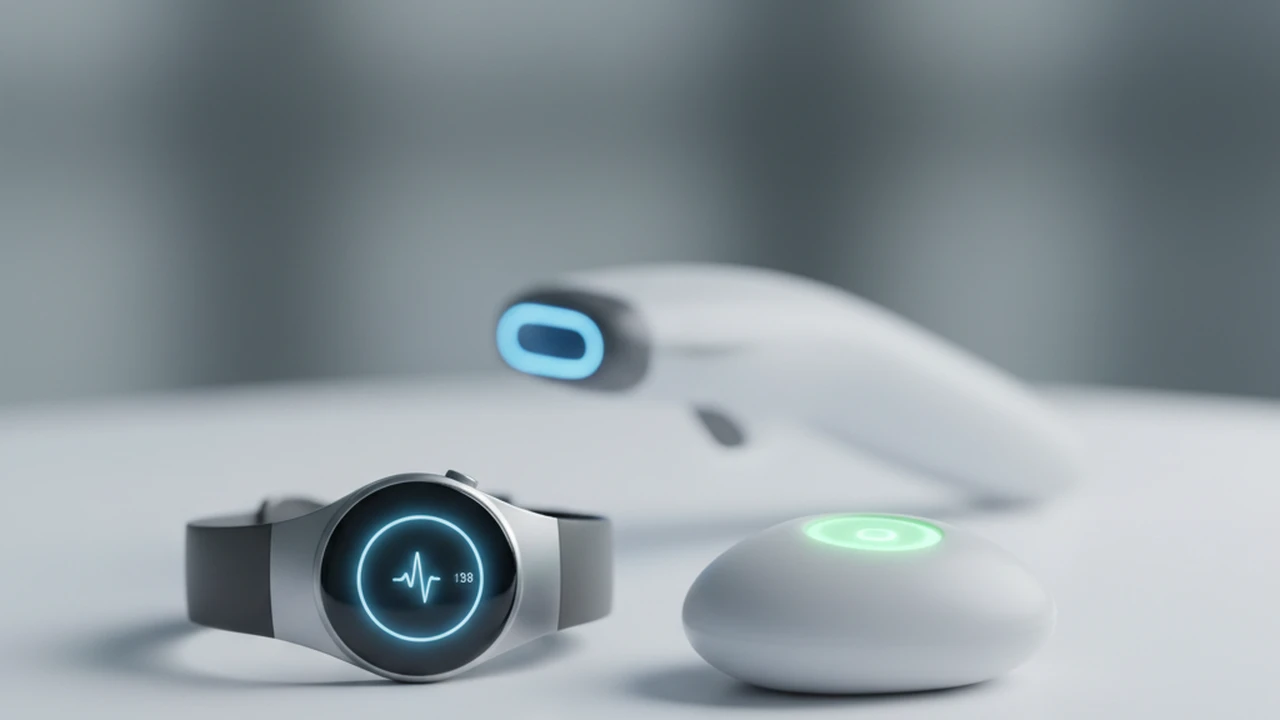
Top 4 AI Solutions for Better Sleep Hygiene
Explore cutting-edge AI solutions designed to make virtual reality experiences more immersive, interactive, and personalized. Discover how AI is revolutionizing VR.

Top 4 AI Solutions for Enhancing Virtual Reality Experiences
Meta description: Explore cutting-edge AI solutions designed to make virtual reality experiences more immersive, interactive, and personalized. Discover how AI is revolutionizing VR.
Virtual Reality (VR) has come a long way, transforming from a niche technology into a powerful medium for entertainment, education, training, and social interaction. But what if we told you that VR is about to get even better? Enter Artificial Intelligence (AI). The synergy between AI and VR is unlocking new levels of immersion, interactivity, and personalization that were once the stuff of science fiction. AI isn't just enhancing VR; it's fundamentally reshaping what's possible within virtual worlds.
The AI VR Revolution What It Means for You
Think about your current VR experiences. They might be visually stunning, but often, the interactions can feel a bit rigid. AI is injecting a new level of dynamism and intelligence into these virtual environments. It's about creating worlds that feel more alive, characters that behave more realistically, and experiences that adapt to you, the user, in real-time. This isn't just about better graphics; it's about deeper engagement and more meaningful interactions.
For consumers, this means more believable game characters, more intuitive virtual assistants, and educational experiences that cater precisely to your learning pace. For businesses, it translates to more effective training simulations, more realistic product design and prototyping, and more engaging virtual customer service. The potential applications are vast and continue to expand as AI technology matures.
1 NVIDIA Omniverse A Collaborative Metaverse Engine
NVIDIA has been at the forefront of graphics technology for decades, and their foray into AI-powered virtual worlds with Omniverse is a game-changer. Omniverse is essentially a platform for collaboration and simulation, built for a virtual world. It allows multiple users to connect and work together in real-time on complex 3D projects, regardless of the software they are using.
Key Features and Benefits
- Real-time Collaboration: Teams can work on the same virtual scene simultaneously, seeing each other's changes instantly. This is crucial for design, architecture, and content creation workflows.
- Physically Accurate Simulation: Leveraging NVIDIA's RTX technology, Omniverse can render scenes with incredible realism, simulating light, materials, and physics with high fidelity.
- AI Integration: Omniverse is designed to integrate AI tools seamlessly. This includes AI-powered content creation tools, intelligent agents within simulations, and AI for optimizing rendering performance. For instance, AI can be used to generate textures, animate characters, or even create entire virtual environments based on simple inputs.
- USD Support: It uses the Universal Scene Description (USD) framework, an open-source standard for interoperability, making it compatible with a wide range of 3D tools like Maya, Blender, and Unreal Engine.
Use Cases
NVIDIA Omniverse is finding applications in:
- Product Design and Manufacturing: Engineers can collaborate on designing complex machinery or vehicles in a virtual space, testing them under simulated conditions before physical prototypes are built.
- Architecture and Construction: Architects and clients can walk through virtual models of buildings, making design changes collaboratively in real-time.
- Media and Entertainment: Filmmakers and game developers can use Omniverse to create virtual sets, animate characters, and collaborate on visual effects.
- Robotics Simulation: Training robots in simulated environments before deploying them in the real world, using AI to teach them tasks and ensure safety.
Pricing
NVIDIA Omniverse Enterprise is available through subscription, with pricing varying based on the number of users and required features. There is also a free version, Omniverse Nucleus, for individual users and small teams to get started.
2 DeepMotion AI for Character Animation
Bringing characters to life in VR is a monumental task. Traditional motion capture is expensive and time-consuming. DeepMotion offers a revolutionary AI-powered solution that converts 2D or 3D video footage into high-quality 3D character animations. This dramatically lowers the barrier to entry for creating realistic character movements in VR.
Key Features and Benefits
- Video to Animation: Simply upload a video of a person performing an action, and DeepMotion's AI analyzes the motion and generates a 3D animation file.
- AI-Powered Retargeting: The generated animations can be automatically retargeted to different 3D character models, saving significant rigging and animation time.
- Customizable Output: Users can fine-tune the animations, adjust parameters, and export them in various formats compatible with popular game engines and 3D software.
- Accessibility: It democratizes character animation, making it accessible to indie game developers, VR creators, and even hobbyists without extensive animation expertise.
Use Cases
DeepMotion is ideal for:
- VR Game Development: Quickly animating player characters, NPCs, and environmental interactions.
- Virtual Avatars: Creating lifelike avatars for social VR platforms and virtual meetings.
- Animated Content Creation: Producing animated shorts, explainer videos, and virtual performances.
- Training Simulations: Animating virtual instructors or trainees for realistic simulation scenarios.
Pricing
DeepMotion offers several pricing tiers, including a free trial. Paid plans typically start around $20-$50 per month for individuals, with higher tiers for professional studios requiring more features and processing power.
3 Unreal Engine 5 AI Features for Immersive Worlds
Unreal Engine (UE) is one of the most powerful and widely used game engines in the world, and its latest iteration, Unreal Engine 5, is packed with AI-driven features that significantly enhance VR development. Epic Games has integrated AI in ways that streamline workflows and enable more sophisticated virtual experiences.
Key Features and Benefits
- Nanite and Lumen: While not strictly AI, these rendering technologies (virtualized micropolygon geometry and dynamic global illumination) work in tandem with AI to deliver unprecedented visual fidelity in real-time, crucial for believable VR.
- AI Pathfinding and Navigation: UE5 includes advanced AI systems for character navigation, allowing NPCs to move intelligently through complex environments, react to dynamic changes, and avoid obstacles realistically.
- Machine Learning Integration: Developers can integrate machine learning models directly into their projects for various purposes, such as procedural content generation, intelligent character behavior, and adaptive difficulty in games.
- MetaHumans: This technology allows for the creation of highly realistic digital humans, powered by sophisticated rigging and animation systems that can be further enhanced with AI for more natural movement and expression.
Use Cases
Unreal Engine 5 is a go-to for:
- High-Fidelity VR Games: Creating visually stunning and interactive VR games with believable characters and environments.
- Architectural Visualization: Building realistic virtual walkthroughs of properties.
- Virtual Production: Used in filmmaking for creating virtual sets and real-time rendering of scenes.
- Simulations and Training: Developing complex training environments for various industries.
Pricing
Unreal Engine is free to use. However, Epic Games takes a 5% royalty on gross revenue for products that generate over $1 million USD in lifetime revenue.
4 OpenAI GPT Models for Intelligent Virtual Agents and NPCs
While not exclusively a VR platform, OpenAI's Generative Pre-trained Transformer (GPT) models, like GPT-4, are revolutionizing how we interact with AI within virtual environments. These large language models can power incredibly sophisticated virtual agents, NPCs, and even generate dynamic dialogue and narratives.
Key Features and Benefits
- Natural Language Understanding and Generation: GPT models can understand complex user queries and generate human-like responses, enabling natural conversations with virtual characters.
- Dynamic Dialogue: Instead of pre-scripted lines, NPCs powered by GPT can engage in spontaneous, context-aware conversations, making virtual worlds feel much more alive and responsive.
- Content Generation: GPT can be used to generate in-game text, lore, quest descriptions, and even entire storylines, adding depth and replayability to VR experiences.
- Personalized Interactions: AI agents can learn from user interactions to tailor their responses and behavior, creating a more personalized and engaging experience.
Use Cases
OpenAI's GPT models are being integrated into:
- Social VR Platforms: Powering virtual assistants or companions that users can interact with naturally.
- VR Games: Creating NPCs with unique personalities and the ability to hold meaningful conversations, enhancing immersion and storytelling.
- Educational VR: Developing virtual tutors or historical figures that can engage users in interactive learning dialogues.
- Virtual Customer Service: Building AI-powered agents for customer support within virtual environments.
Pricing
OpenAI offers API access to its GPT models. Pricing is typically based on the amount of data processed (tokens). For example, GPT-4 access can range from $0.03 to $0.06 per 1,000 tokens, depending on the model version and usage. This requires developers to integrate the API into their VR applications.
Comparing AI Solutions for VR Enhancement
Choosing the right AI solution depends heavily on your specific needs and project scope. Here's a quick comparison:
- NVIDIA Omniverse: Best for collaborative 3D workflows, high-fidelity simulations, and building interconnected virtual worlds. It's a comprehensive platform for professional creators.
- DeepMotion: Ideal for developers needing to quickly and affordably create realistic 3D character animations from video. It democratizes animation for VR content.
- Unreal Engine 5: A powerful all-in-one solution for building visually stunning and interactive VR experiences, with integrated AI tools for navigation, behavior, and rendering. Great for game development and complex simulations.
- OpenAI GPT Models: Perfect for adding intelligent conversational AI, dynamic dialogue, and narrative generation to VR experiences. It focuses on the 'brain' and interaction aspect of virtual characters and agents.
Many projects will likely benefit from a combination of these tools. For instance, you might use Unreal Engine 5 to build your VR world, DeepMotion to animate your characters, and OpenAI's GPT to give those characters intelligent dialogue.
The Future is AI-Powered VR
The integration of AI into virtual reality is not just an incremental improvement; it's a paradigm shift. These AI solutions are making VR more accessible, more realistic, more interactive, and ultimately, more valuable. As AI continues to evolve, we can expect even more sophisticated and mind-blowing VR experiences that blur the lines between the digital and physical worlds. Whether you're a gamer, a creator, an educator, or a business professional, the future of VR is undeniably intertwined with the power of artificial intelligence.